Secret Erasure
In this chapter, we will exercise the RELational Symbolic Execution engine of BINSEC to check that no secret data remains in memory after returning from a given function, also known as the secret-erasure property.
Indeed, a critical section should not keep the secret data in memory longer than necessary to prevent an attacker from exploiting a memory disclosure vulnerability and accessing the stored secret. Such code can thus use a so-called scrubbing function to fill the secret storage with public data (e.g. all zeros). Unfortunately, the compiler may consider such writes as dead assignments and optimize them out, leaving the executable code unprotected.
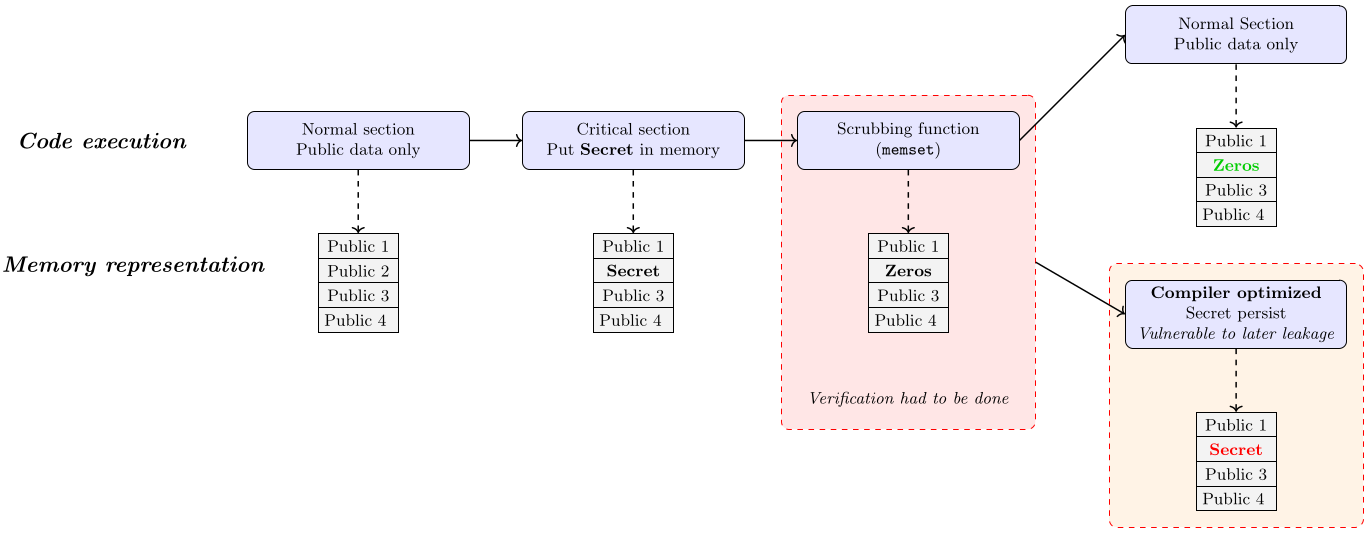
The relational analysis plugin checkct proposes a secret-erasure check inspired by the Daniel et al. paper to ensure that memory does not contain any secret past a given point (a function return in this tutorial).
We will use a binary challenges from the original RELSE benchmark repository.
Test harness
The benchmark challenges have been compiled with the following test harness.
#define __STDC_WANT_LIB_EXT1__ 1
#include <string.h>
#include <stdlib.h>
#include <stddef.h>
#include <stdlib.h>
#include <assert.h>
#include <stdio.h>
#include "safeclib/include/safe_mem_lib.h"
#include "../__libsym__/sym.h"

/* --------------- SCRUBBING FUNCTIONS ------------------ */
/* Implement your own using the following declaration */

/* [ ... ] */

/* Scrubbing function using memset */
#if MEMSET
void scrub(char *buf, size_t size) {
  memset(buf, 0, size);
}
#endif

/* [ ... ] */

/* --------------- END OF SCRUBBING FUNCTIONS ------------------ */

#define PASSWORD_SIZE 32

/* Volatile so everything is not optimized away */
volatile char good = 0;

void get_secret(char *bufer) {
  // This function is stubbed in SE and puts secret data into bufer
  HIGH_INPUT(PASSWORD_SIZE)(bufer);
}

/* Function that read and check the password */
void __attribute__ ((noinline)) password_checker(char *attempt) {
  char password[PASSWORD_SIZE];

  /* Put secret data in [password] */
  get_secret(password);

  /* Compares attempt to the secret password */
  good = 1;
  for (unsigned int i = 0; i < PASSWORD_SIZE; ++i) {
    good = good & (password[i] == attempt[i]);
  }

  // Scrubs secret from memory
  scrub(password, PASSWORD_SIZE);
}


int main () {
  char attempt[PASSWORD_SIZE];
  LOW_INPUT(PASSWORD_SIZE)(attempt);

  password_checker(attempt);

  /* Ideally we should declassify good */
  scrub((char *) &good, 1);
  return 0;
}
First (secure) candidate
We will start with the basic memset variant compiled without optimization (O0) .
To simplify the initialization, we will start from a core dump, as seen in the Core dump chapter.
starting from core
explore all
check secret erasure over <main>

replace <high_input_32> (ptr) by
  @[ptr, 32] := secret as high_input_32
  return
end

replace <low_input_32> (ptr) by
  @[ptr, 32] := public as low_input_32
  return
end
- Browser
- Command-line
Download or copy the content of the script in the file secret_erasure.ini, then run the following command.
Then download the snapshot and the sysroot archives
tar xzf secret-erasure_MEMSET_O0_gcc_10.2.0.snapshot.tar.gz
tar xzf secret-erasure_MEMSET_O0_gcc_10.2.0.sysroot.tar.gz --one-top-level=sysroot
binsec -sse -checkct -sse-script secret_erasure.ini secret-erasure_MEMSET_O0_gcc_10.2.0.snapshot -sse-sysroot sysroot
[sse:info] Empty path worklist: halting ...
[sse:info] SMT queries
         Preprocessing simplifications
           total          14
           sat            14
           unsat          0
           time           0.00

         Satisfiability queries
           total          1
           sat            0
           unsat          1
           unknown        0
           time           0.27
           average        0.27

       Exploration
         total paths                      1
         completed/cut paths              1
         pending paths                    0
         discontinued paths               0
         failed assertions                0
         branching points                 37
         max path depth                   687
         visited instructions (unrolled)  687
         visited instructions (static)    138


[checkct:result] Program status is : secure (0.314)
[checkct:info] 1 visited path covering 138 instructions
[checkct:info] 51 / 51 control flow checks pass
[checkct:info] 637 / 637 memory access checks pass
[checkct:info] 1 / 1 secret erasure checks pass
Here, the only thing new is the check secret erasure over <main> command to instruct BINSEC to check the property at the function <main> return.
As expected, the function memset was called and the secret was erased from the memory.
We replaced the library function high_input_32 and low_input_32 to produce, respectively a secret or a public value of 32 bytes.
Second (insecure) candidate
Now, let us put it to the test with an optimizing compiler: we will try memset variant compiled with some optimization (O2) .
starting from core
explore all
check secret erasure over <main>

replace <high_input_32> (ptr) by
  @[ptr, 32] := secret as high_input_32
  return
end

replace <low_input_32> (ptr) by
  @[ptr, 32] := public as low_input_32
  return
end
- Browser
- Command-line
Download or copy the content of the script in the file secret_erasure.ini, then run the following command.
Then download the snapshot and the sysroot archives
tar xzf secret-erasure_MEMSET_O2_gcc_10.2.0.snapshot.tar.gz
tar xzf secret-erasure_MEMSET_O2_gcc_10.2.0.sysroot.tar.gz --one-top-level=sysroot
binsec -sse -checkct -sse-script secret_erasure.ini secret-erasure_MEMSET_O2_gcc_10.2.0.snapshot -sse-sysroot sysroot
[checkct:result] Secret-erasure check failure @ 0x8049680 (0.044s)
             @ :
                0xffa2f9d2 : 0x00

             public :
                low_input_32 : 0x0000000000000000000000000000000000000000000000000000000000000000

             secret1 :
                high_input_32 : 0x0000000000000000000000000000000000000000000000000000000000ff0000

             secret2 :
                high_input_32 : 0x00000000000000000000000000000000000000000000000000000000007f7f7f

[sse:info] Empty path worklist: halting ...
[sse:info] SMT queries
         Preprocessing simplifications
           total          3
           sat            3
           unsat          0
           time           0.00

         Satisfiability queries
           total          1
           sat            1
           unsat          0
           unknown        0
           time           0.01
           average        0.01

       Exploration
         total paths                      1
         completed/cut paths              1
         pending paths                    0
         discontinued paths               0
         failed assertions                0
         branching points                 32
         max path depth                   324
         visited instructions (unrolled)  324
         visited instructions (static)    48


[checkct:result] Program status is : insecure (0.044)
[checkct:info] 1 visited path covering 48 instructions
[checkct:info] 35 / 35 control flow checks pass
[checkct:info] 284 / 284 memory access checks pass
[checkct:info] 0 / 1 secret erasure checks pass