Checking Constant Time Property
By carefully measuring the amount of time required to perform private key operations, attackers may be able to find fixed Diffie-Hellman exponents, factor RSA keys, and break other cryptosystems.
Timing Attacks on Implementations of Diffie-Hellman, RSA, DSS, and Other Systems, 1996, Paul Kocher
Constant-time programming is a programming technique with the objective of ensuring that a given implementation does not leak information over any sensitive data (e.g. private cryptographic keys) through a timing side channel.
Indeed, a run may take more or less time depending on the path taken (control flow leak), and on almost any modern processor, timing may also vary depending on its cache behavior (memory access leak).
To detect this behaviour, BINSEC verifies that no sensitive data (tagged as secret) affects the control flow decision: whatever the secrets, two runs with the same other inputs (tagged as public) will follow the same path. At the same time, it also verifies that these two runs will always access the same addresses in memory.
We will illustrate this with the function memcmp.
The memcmp function
We will use the usual definition of the function.
int memcmp(const void *s1, const void *s2, size_t n);
The memcmp function compares the first n bytes of the memory areas s1 and s2. It returns an integer less than, equal to, or greater than zero if the the first n bytes of s1 is found, respectively, to be less than, to match, or be greater than the first n bytes of s2.
Test harness
In order to ease the verification process, we will rely on the following test harness.
#include <stdlib.h>

int memcmp(const void *s1, const void *s2, size_t n); /* function under analysis */

#define SIZE (1 << 4) /* 16B */
char s1[SIZE];   /* secret buffer */
char s2[SIZE];   /* public buffer */
size_t n = SIZE; /* public variable */

int main(int argc, char *argv[])
{
	int res = memcmp(s1, s2, n);

	/* ensure the result is in [-1..1] */
	res |= res >> 1;
	res |= res >> 2;
	res |= res >> 4;
	res |= res >> 8;
	res |= res >> 16;
	res = (res & 1) | (res >> 31);

	exit(res); /* identify halting point and prevent compiler optimizations */
}
It just wraps the call to memcmp and performs a constant-time reduction of its result before calling the exit function.
It is not strictly necessary, but using the result of memcmp as an argument to exit helps preventing the compiler from optimizing the call away.
This test harness will allow us to configure more easily the relational engine of BINSEC. Indeed, it gives us a well known starting point (main), a named ending point (exit) and several global symbols to mark as public or secret (s1, s2 and n).
This allow to setup a minimal script as follows.
starting from <main>

with concrete stack pointer
secret global s1
public global s2, n

assume 0 < n < 10

halt at <exit>
explore all
The analysis will start from main, trying to explore all paths that reach exit. We mark the variable s1 as secret while s2 and n are tagged public.
We can further add constraints on these symbolic variables. For instance, here we limit the number of rounds (size) in the range[1..9].
We also concretize the stack pointer. Otherwise, the analysis would likely be stuck reasoning on non meaningful memory aliasing.
First (non constant-time) candidate
Here is a common way to implement the function memcmp.
#include <stddef.h>

int memcmp(const void *s1, const void *s2, size_t n)
{
    const char *p1 = (const char *)s1, *p2 = (const char *)s2;
    for (size_t i = 0; i < n; i += 1) {
        if (p1[i] < p2[i]) return -1;
        else if (p1[i] > p2[i]) return 1;
    }
    return 0;
}
Let us run BINSEC on its compiled version .
- Browser
- Command-line
Download or copy the content of the script in the file constant_time.ini, then run the following commands.
gcc -g -static test_harness.c test_memcmp_1.c -o constant_time_1
- Run BINSEC :
binsec -sse -checkct -sse-script constant_time.ini constant_time_1
[checkct:result] Instruction 0x401933 has control flow leak (0.271s)
[checkct:result] Instruction 0x40195a has control flow leak (0.329s)
... details
[sse:info] Empty path worklist: halting ...
[sse:info] SMT queries
             Preprocessing simplifications
               total          56
               sat            56
               unsat          0
               time           0.00

             Satisfiability queries
               total          29
               sat            27
               unsat          2
               unknown        0
               time           0.43
               average        0.01

           Exploration
             total paths                      27
             completed/cut paths              27
             pending paths                    0
             discontinued paths               0
             failed assertions                0
             branching points                 28
             max path depth                   273
             visited instructions (unrolled)  1045
             visited instructions (static)    83
[checkct:result] Program status is : insecure (0.761)
[checkct:info] 27 visited paths covering 83 instructions
[checkct:info] 37 / 39 control flow checks pass
[checkct:info] 781 / 781 memory access checks pass
So now, we know that this candidate for memcmp is not constant time.
Get a detailled report
We can go further by asking BINSEC detailed models of the leaks found using the option -checkct-stats-file.
- Browser
- Command-line
Pursue with the precedent script constant_time.ini or download it again here , then run the following commands.
binsec -sse -checkct -sse-script constant_time.ini -checkct-stats-file candidate_1.toml constant_time_1
["Insecurity models".0x401933.public]
n = ["0x0000000000000009"]
rbp = ["0x00000000253bd717"]
rdi = ["0x0000000018b9dc41"]
rsi = ["0x000000000f221c28"]
s2 = ["0x0000000000000000000000003f17e152"]
["Insecurity models".0x401933.secret1]
s1 = ["0x0000000000000000000000000266bf66"]
["Insecurity models".0x401933.secret2]
s1 = ["0x8b0743af2001212034a2a4f39af06b9a"]
["Insecurity models".0x40195a.public]
n = ["0x0000000000000001"]
rbp = ["0x00000000253bd717"]
rdi = ["0x0000000018b9dc41"]
rsi = ["0x000000000f221c28"]
s2 = ["0x00000000000000000000000000000000"]
["Insecurity models".0x40195a.secret1]
s1 = ["0x00000000000000000000000000000000"]
["Insecurity models".0x40195a.secret2]
s1 = ["0x00000000000000000000000000000001"]
["Instructions status"]
insecure = ["0x401933", "0x40195a"]
unknown = []
The report contains entries for each detected leak. It also gives a possible valuation of the public and secret values declared in the script. Here BINSEC found solutions for the value s1 resolving the paths explored.
We have here a translation from our report (1st leak) to a C initialization.
["CT report"."Insecurity models".0x401933.public]n = ["0x00000009"]rbp = ["0x000000001bdd779f"]rdi = ["0x00000000370cb0b9"]rsi = ["0x000000000e3ba79b"]s2 = ["0x0000000000000000000000003427bece"]["Insecurity models".0x401933.secret1]s1 = ["0x0000000000000000000000001a802092"]["Insecurity models".0x401933.secret2]s1 = ["0xffffffffffffffffffffffffffffffff"]
size_t n = 0x00000009;/* public 0x0000000000000000000000003427bece */char s2[SIZE] = {0xce, 0xbe, 0x27, 0x34, 0x00, 0x00, 0x00, 0x00,0x00, 0x00, 0x00, 0x00, 0x00, 0x00, 0x00, 0x00};/* secret 1 0x0000000000000000000000001a802092 */char s1[SIZE] = {0x92, 0x20, 0x80, 0x1a, 0x00, 0x00, 0x00, 0x00,0x00, 0x00, 0x00, 0x00, 0x00, 0x00, 0x00, 0x00};/* secret 2 0xffffffffffffffffffffffffffffffff */char s1[SIZE] = {0xff, 0xff, 0xff, 0xff, 0xff, 0xff, 0xff, 0xff,0xff, 0xff, 0xff, 0xff, 0xff, 0xff, 0xff, 0xff};
In C, the content of the buffer is written in little endian whereas the bitvector given by the model is written in big endian. Bytes have to be swapped between the two representations. It is not the case for the variable n (integer) that is written in big endian both in C and in the model.
Since we compiled the binary with debug information (-g), we can further try to link back the leak to the C code. For instance, the following command shows the mapping between lines in C and program addresses`.
Let us find out the bad addresses in our implementation
$ objdump --dwarf=decodedline candidate_1
Here, we can find that the address of the leak at 0x401933 is between 0x401931 and 0x401935 and thus matches the line 7 in candidate_1.c.
File name                            Line number    Starting address    View    Stmt
...
candidate_1.c                                  7            0x401923               x
candidate_1.c                                  7            0x401931               x
candidate_1.c                                  7            0x401935               x
candidate_1.c                                  7            0x40193a
candidate_1.c                                  8            0x40193c               x
Second (constant-time) candidate
Here is another way to implement the function memcmp, designed for a constant-time compliance.
#include <stddef.h>

int memcmp(const void *s1, const void *s2, size_t n)
{
    const char *p1 = (const char *)s1, *p2 = (const char *)s2;
	int res = 0;
    for (size_t i = 0; i < n; i += 1) {
		res = res | (~(res >> 31) & ((res - 1) >> 31) & (p1[i] - p2[i]));
    }
    return res;
}
- Browser
- Command-line
Download or copy the content of the script in the file constant_time.ini, then run the following commands.
gcc -g -static test_harness.c test_memcmp_2.c -o constant_time_2
- Run BINSEC :
binsec -sse -checkct -sse-script constant_time.ini constant_time_2
[checkct:result] Program status is : secure (1.230)
[checkct:info] 9 visited paths covering 83 instructions
[checkct:info] 19 / 19 control flow checks pass
[checkct:info] 359 / 359 memory access checks pass
Remember that BINSEC only performs bounded verification. The result is valid given the initial assumption, for instance that the size n is lower than 10.
Threat to completeness
BINSEC has 3 outputs possibles:
- the program is
insecureas long as one leak has been detected along any visited path; - the program is
secureif no leak has been detected and that all paths have been explored; - the program has an
unknownstatus if no leak has been detected so far but at least one check or the whole exploration has been interrupted prematurely.
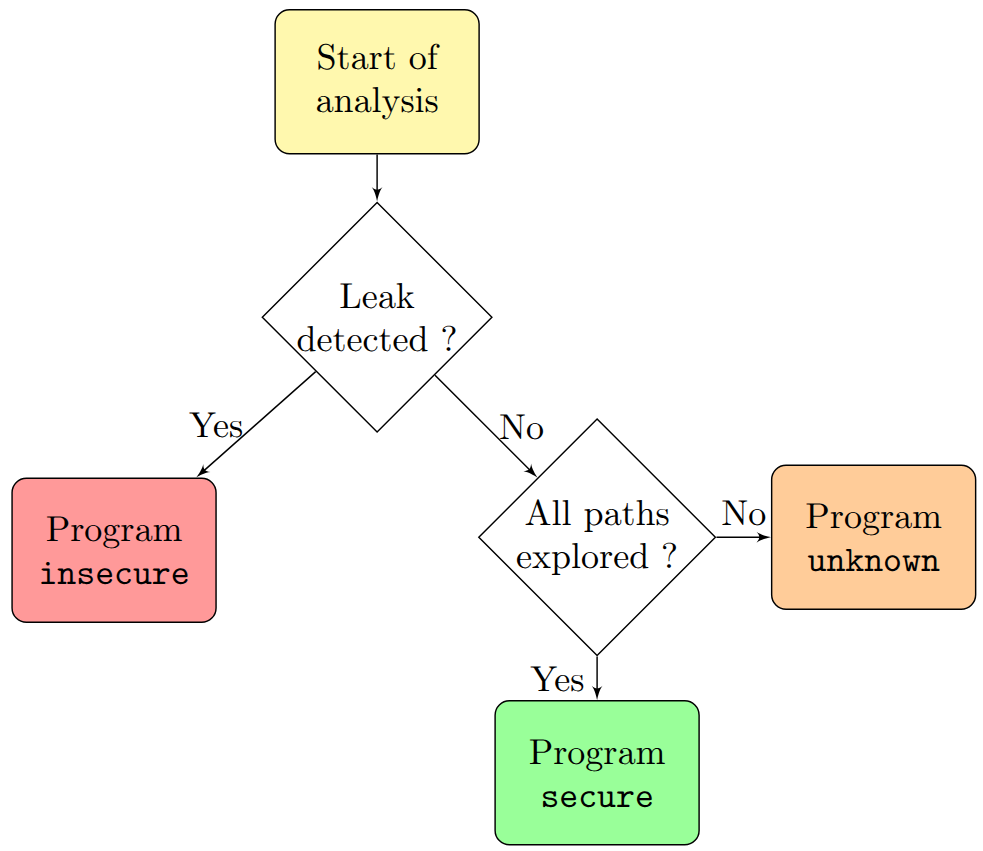
As an under-approximated technique, it is thus easier to prove a program violates the constant-time coding discipline than to prove that it is compliant.